
Congrats to the Chronicles of EMS team for the debut of their new program: Fire Responders Network.tv.
This great new network uses the power of entertainment, education, technology and partnership to work with and improve the health care industry. If you're an EMT, firefighter, filmmaker, social media expert, or just interested in our nation's EMS and health care system, make sure to check out this new platform to learn about the latest EMS news.
Monday, March 14, 2011

Thursday, March 10, 2011
FIRESTORM screened at EMS Today
 Filmmaker Julie Winokur and I traveled to Baltimore last week to present FIRESTORM at this year's EMS Today conference. Although we were only there from Thursday to Friday, our schedules were jammed pack. From attending a few educational sessions and exploring the exhibition floor to meeting up with old EMS friends and networking with new ones, EMS Today was a great success as well as a blast!
Julie was interviewed by GenMed host Natalie Queubedeaux and we also met up with EMS bloggers Chris Kaiser (Life Under The Lights) and Scott Kier (EMS in the New Decade), podcaster Jamie Davis (the Podmedic), and Ted Setla, Justin Schorr, and Sam Bradley of Chronicles of EMS. We also met paramedics from other countries including Switzerland and Germany. It was amazing to hear their thoughts after watching FIRESTORM and to compare notes about each of our country's EMS and health care system.
With a turnout of about 80-100 people, Julie and I couldn't have been more pleased with the screening of FIRESTORM. The more EMS professionals we show the film to, the greater the reach of our outreach campaign. And the greater the outreach campaign, the greater the chance
 of successfully reducing overcrowding in our nation's EDs.
So many EMTs tell us "ER overcrowding, wall delays, ambulance diversion -- all of this is currently happening in my community too!" Unfortunately, it's the public at large who remain unaware and uneducated about our nation's EMS crisis. Communities across the US (both urban and rural) are facing the same ER problems as seen in Los Angeles, and (as many of us discussed at the conference) 'If these problems exist on a day-to-day basis across the country, then how can EMS be prepared for and adequately respond to a disaster situation?' Americans have no idea that our EMS systems are overwhelmed and facing dire circumstances. That's why opportunities such as screening at EMS Today is so important to our film and campaign's success....We need more EMS members to learn about FIRESTORM so they can then use the film as a tool for advocacy and awareness in their communities.

Thank you to EMS Today for giving us this opportunity and to all our EMS friends for supporting our film and helping us spread the word. Our nation's EMS system is made up of such dedicated, skilled, intelligent, and humble men and women. It was such a privilege to be welcomed into their tight knit community with open arms.
P.S. Thank you to our Swiss fans for sharing your pictures with us! (From left to right: Ra, Julie, Elmar, Elissa, and Helge.)

Tuesday, January 25, 2011
Insult to Injury
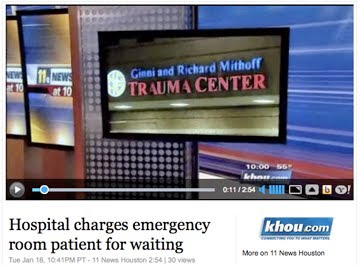
A man in Texas spent 6 hours in an ER waiting room with a sore ankle, got fed up and left without being seen. A few weeks later, he received a bill from the hospital for more than $100. The patient was told such billing was "standard procedure." After a local news station got involved, the bill was revoked and the incident was resolved.
Watch the report on KHOU.com.
What's unclear, is how often this sort of thing happens and how many patients are billed inappropriately.
Friday, October 1, 2010
Firestorm Screens at EMS Expo
 FIRESTORM screened twice this week at the EMS Expo and Conference at the Dallas Convention Center in Dallas, Texas. The conference features educational workshops and labs by industry professionals as well as the latest EMS products, technologies and innovation.
Both on Thursday, September 30 and Friday, October 1, director Julie Winokur was on hand to screen her film and answer questions from the audience. Check out some photos from the expo:


Update on our June 23 post ("LAC+USC 'Dangerously Overcrowded' ")
Emergency department services in LA County's USC hospital continue to worsen according to an article from MercuryNews.com.
In August 2010, overcrowding took place 98 percent of the time, up from 80 percent in July. As a result, "adults arriving in the emergency room wait an average 12 1/2 hours from the time they are triaged until they are admitted or discharged."
Thursday, August 26, 2010
A new trend is unfolding: ERs across the country are posting their wait times online, via text, and even on a flashing billboard. With ER usage at a record high, hospitals are struggling to keep the wait times down, and this is one effort to dissipate the patient load.
According to an article by the Associated Press, "There are no statistics on how many hospitals advertise wait times, although they tend to have multiple ERs in a region, usually the suburbs. The idea: People with less urgent conditions — maybe they need stitches for a cut — might drive a bit farther for a shorter wait, possibly helping a hospital chain spread the load without losing easier cases to competitors."
Hospitals are trying everything from "team triage" — where patients are met by a doctor, nurse and paramedics at the front door — to "hallway medicine," where patients on guerneys are divided by the severity of their condition and given nursing attention in hallways.
These measures all point to a shortage of hospital in-patient beds and a poor system for directing non-urgent cases to appropriate places for care. Perhaps it's time to redefine "ER" so we preserve this valuable resource for true emergencies.
According to an article by the Associated Press, "There are no statistics on how many hospitals advertise wait times, although they tend to have multiple ERs in a region, usually the suburbs. The idea: People with less urgent conditions — maybe they need stitches for a cut — might drive a bit farther for a shorter wait, possibly helping a hospital chain spread the load without losing easier cases to competitors."
Hospitals are trying everything from "team triage" — where patients are met by a doctor, nurse and paramedics at the front door — to "hallway medicine," where patients on guerneys are divided by the severity of their condition and given nursing attention in hallways.
These measures all point to a shortage of hospital in-patient beds and a poor system for directing non-urgent cases to appropriate places for care. Perhaps it's time to redefine "ER" so we preserve this valuable resource for true emergencies.
Friday, August 13, 2010
New JAMA report highlights America's ER crisis
Los Angeles is definitely not the only city experiencing a crisis in emergency care. Firestorm captures this national trend, but for those who remain skeptic about the severity of this issue then check out The Journal of the American Medical Association's recent report on national ER visits.
One of the report's findings: the number of patient visits in emergency rooms nationwide rose from 95 million to 117 million in 10 years. You may think "But ER visits will obviously increase with the growth of population, so what's the big deal?" The big deal is that while the number of patient visits grew 23%, only HALF of that increase can be attributed to the population growth. AND as the demand for ERs grew by this surge in visits, the number of ERs dropped by 5%.
Learn more about the JAMA report in this LA Times' Health Care blog post: Emergency rooms are getting more crowded everywhere, study finds
One of the report's findings: the number of patient visits in emergency rooms nationwide rose from 95 million to 117 million in 10 years. You may think "But ER visits will obviously increase with the growth of population, so what's the big deal?" The big deal is that while the number of patient visits grew 23%, only HALF of that increase can be attributed to the population growth. AND as the demand for ERs grew by this surge in visits, the number of ERs dropped by 5%.
So, still not convinced our nation has an emergency medical care problem??
Learn more about the JAMA report in this LA Times' Health Care blog post: Emergency rooms are getting more crowded everywhere, study finds
Wednesday, July 14, 2010
FIRESTORM now available for purchase!
FIRESTORM is now available to purchase on DVD for institutional use, community screenings, or personal viewing. To buy a DVD online through TEM please click here.
Subscribe to:
Posts (Atom)


