Firestorm: ED
Showing posts with label ED. Show all posts

Tuesday, June 14, 2011

Ambulance Diversions Decrease Survival Rates for Heart Attack Victims


The Journal of the American Medical Association (JAMA) just released a new study showing that heart attack victims were less likely to survive when hospital EDs were overcrowded and ambulances were diverted.

As one USA Today reader responded:

Wait now, so they are saying if you have a heart attack, and get the proper care and treatment at a hospital later rather than sooner, it leads to higher death rates?? Gosh, who would have thought that Batman.

The study looked at more than 13,000 Medicare patients in four California counties and concluded that hospital EDs that were on diversion at least 12 hours a day had higher mortality rates for patients suffering cardiac arrest.

Dr. Renee Hsia of UCSF, one of the lead researchers on the study explains, "In fact, for every 100 patients who are unfortunate enough to have a heart attack when ambulances are being diverted for long periods of time, our study shows that there are three potentially avoidable deaths.”

Tuesday, January 25, 2011

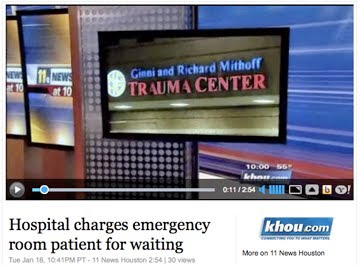
Insult to Injury


A man in Texas spent 6 hours in an ER waiting room with a sore ankle, got fed up and left without being seen. A few weeks later, he received a bill from the hospital for more than $100. The patient was told such billing was "standard procedure." After a local news station got involved, the bill was revoked and the incident was resolved.

Watch the report on KHOU.com.

What's unclear, is how often this sort of thing happens and how many patients are billed inappropriately.

Thursday, August 26, 2010

A new trend is unfolding: ERs across the country are posting their wait times online, via text, and even on a flashing billboard. With ER usage at a record high, hospitals are struggling to keep the wait times down, and this is one effort to dissipate the patient load.

According to an article by the Associated Press, "There are no statistics on how many hospitals advertise wait times, although they tend to have multiple ERs in a region, usually the suburbs. The idea: People with less urgent conditions — maybe they need stitches for a cut — might drive a bit farther for a shorter wait, possibly helping a hospital chain spread the load without losing easier cases to competitors."

Hospitals are trying everything from "team triage" — where patients are met by a doctor, nurse and paramedics at the front door — to "hallway medicine," where patients on guerneys are divided by the severity of their condition and given nursing attention in hallways.

These measures all point to a shortage of hospital in-patient beds and a poor system for directing non-urgent cases to appropriate places for care. Perhaps it's time to redefine "ER" so we preserve this valuable resource for true emergencies.